

The Hidden Trap in Your Foundation: When Early Paperwork Ruins Everything
A napkin agreement between two co-founders can quietly cost a startup its entire funding round, years after both people forgot the napkin ever existed. Most founders treat incorporation as a form to fill out once, not a legal foundation that gets tested every time an investor's lawyer starts asking questions. The mistakes rarely show up on day one. They show up during due diligence, right when you can least afford to fix them.
Quick Takeaways Before You Incorporate
- If you plan to raise venture capital, form a Delaware C-Corporation from day one, not an LLC.
- Every founder needs a four-year vesting schedule with a one-year cliff, even close friends and family.
- File your Section 83(b) election within 30 days of receiving stock, there are no exceptions or extensions.
- Never mix personal and business finances, doing so can strip away your liability protection entirely.
Navigating the Legal Maze: Unmasking Early Incorporation Traps
To protect your startup's future, you must understand that incorporating a business is not just about getting a state registration certificate.
It is about building a clean, legal framework that defines who owns what, how decisions are made, and how profits are distributed.
Let us explore the most common legal errors first-time founders commit and how you can fix them before they disrupt your growth.
The Entity Selection Error: LLC versus C-Corporation Misalignment
The first big decision you face is choosing the right legal entity structure for your new venture.
Many first-time founders default to forming a Limited Liability Company (LLC) simply because it is cheap, easy to set up, and requires minimal yearly paperwork.
While an LLC is fantastic for local service businesses or consulting agencies, it is often terrible for high-growth tech startups seeking venture capital.
Most institutional venture investors and startup accelerators will only invest in Delaware C-Corporations due to standardized stock structures.
If you form an LLC and later need to raise seed capital, you will have to pay thousands of dollars in legal fees to convert your company into a C-Corporation.
This conversion process takes weeks, slows down your funding momentum, and creates messy tax complications for early members.
Before filing your papers, ask yourself if your business plans to raise outside investor capital or issue employee stock options.
If your answer is yes, starting as a Delaware C-Corporation from day one is usually the cleanest and most cost-effective path.
It sets up a recognized stock framework that makes issuing shares to founders, investors, and early employees simple and transparent.
Myth vs. Reality: Startup Incorporation Legalities
The Co-Founder Equity Disaster: Missing Four-Year Vesting Schedules
Splitting equity equally on day one without a formal vesting schedule is one of the fastest ways to kill a promising business.
Imagine giving your co-founder fifty percent of your company shares on the day you incorporate.
If that co-founder quits three months later because they got a new job offer, they still legally own half of your business forever.
Future investors will refuse to put money into a company where a former employee owns half the stock without doing any work.
To prevent this nightmare, every founder must sign a restricted stock purchase agreement that includes a four-year vesting schedule with a one-year cliff.
Under a standard four-year schedule, founders earn their equity over time—twenty-five percent after the first year (the cliff), and the rest monthly over the next three years.

If a co-founder leaves before the one-year cliff, they walk away with zero equity, protecting the remaining team and the company's cap table.
A Question Founders Often Ask: "What if my co-founder refuses to sign a vesting agreement?" Treat this as a serious warning sign, not a minor negotiation point. A co-founder unwilling to accept standard vesting terms is telling you, before you have spent a single dollar together, exactly how they will act if things get difficult later.
Pro-Level Realization: The Section 83(b) Tax Trap
I once issued early stock to myself and my co-founder without filing a Section 83(b) election with the IRS within our first thirty days. Two years later, when our company valuation jumped, the IRS treated our vested shares as ordinary income, leaving us with a massive tax bill on money we had not even earned yet. My advice is to set an immediate calendar alert for your Section 83(b) filing the exact day you sign your stock purchase agreements.
The Intellectual Property Gap: Unassigned Patents and Code
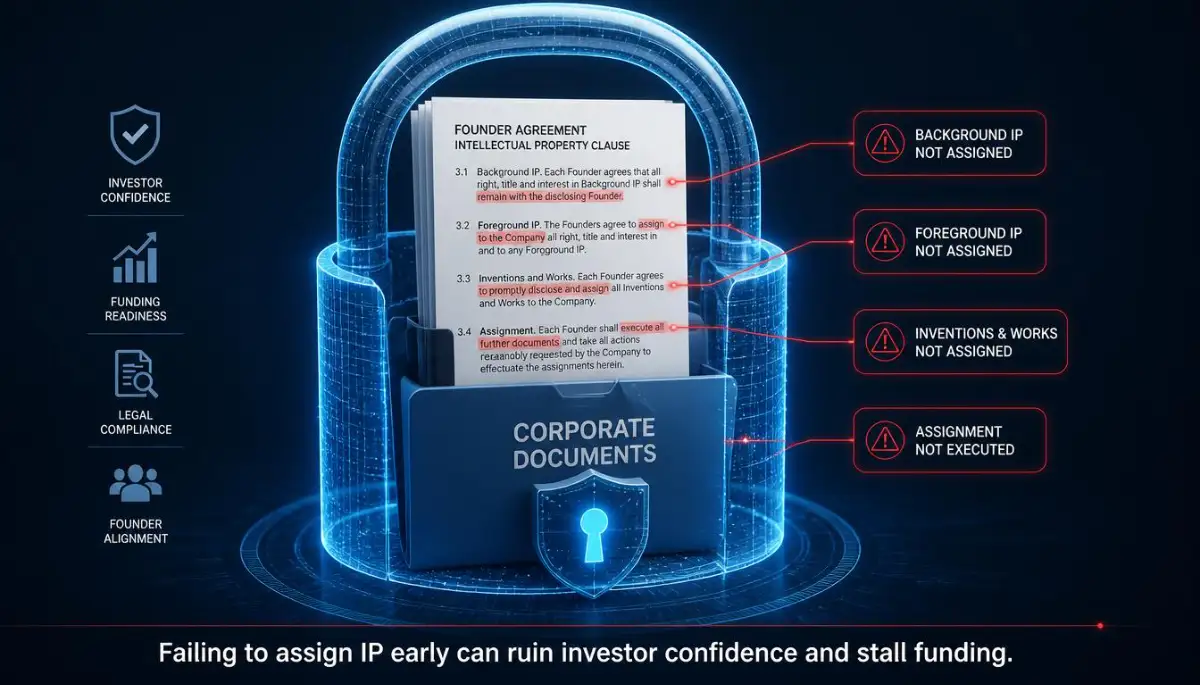
Your startup's most valuable asset is its intellectual property, including your software code, brand designs, trade secrets, and patents.
A massive mistake first-time founders make is assuming that code written before incorporation automatically belongs to the company.
In the eyes of the law, the person who creates an asset owns it individually until they formally transfer those rights in writing.
If your technical co-founder or a freelance developer built your early software prototype on their personal laptop, they own that code personally.
If you do not have every contributor sign a Proprietary Information and Inventions Assignment (PIIA) agreement, your company owns nothing.
Investors will discover this gap during their legal due diligence and will pull their funding offers until the ownership is cleared up.
Protecting Your Technology: Securing Contractor and Founder IP
Ensuring your company owns every line of code requires clear, written legal transfers from day one.
Many startups face sudden legal threats when a former contractor claims they own part of the core software platform.
Want to see a step-by-step screen walk-through of how to properly structure founder IP assignment agreements? Watch this quick, expert video guide before reading about stock filing mistakes below!
Comparing Incorporation Structures: LLC versus C-Corporation
To help you choose the right legal path, let us compare the operational features of the two most common entity types:
Ignoring Securities Laws: The Section 83(b) Election Deadline
When founders issue stock to themselves at the time of incorporation, the shares usually have very little monetary value.
However, as the company grows and raises money, those shares become significantly more valuable over time.
If your stock is subject to a vesting schedule, the IRS views each vested chunk of shares as new income taxable in the year it vests.
To avoid paying income tax on unrealized stock gains, every founder must file a Section 83(b) election form with the IRS.
This election tells the government that you want to pay income tax on the value of the shares on the day they were granted, when the value was near zero.

Here is the dangerous part: you must mail this form to the IRS within thirty days of receiving your stock.
If you miss this strict thirty-day window by even a single day, the IRS cannot grant an extension under any circumstances.
Missing this deadline can force you to pay thousands of dollars in personal income taxes on paper stock wealth that you cannot even sell yet.
Commingling Personal and Corporate Finances
Once your company is incorporated, it becomes a distinct legal person separate from you as an individual.
Many first-time founders make the dangerous error of using their personal credit card to pay for company expenses or taking cash out of the business account for personal use.
This practice is called commingling funds, and it destroys the primary reason you incorporated in the first place: personal liability protection.
If a customer or vendor sues your business, a court can "pierce the corporate veil" if they see that personal and business money were mixed together.
When the corporate veil is pierced, your personal savings, home, and assets can be seized to pay off company debts and legal judgments.
Maintain strict financial boundaries by opening a dedicated business bank account immediately after receiving your corporate tax ID.
Never pay a personal bill from the company account, and keep clear receipts for every business purchase you make.
Pre-Incorporation Legal Checklist
Before you file your corporate registration documents, run through this simple checklist to protect your new business:
- Choose between an LLC and a Delaware C-Corporation based on your long-term investor funding goals.
- Draft a formal restricted stock purchase agreement containing a four-year vesting schedule with a one-year cliff.
- Have every founder, contractor, and employee sign a Proprietary Information and Inventions Assignment (PIIA) contract.
- Mail your completed Section 83(b) election form to the IRS within thirty days of stock issuance using certified mail.
- Open a dedicated business checking account and stop all mixing of personal and company money.
- Record initial board meeting minutes and formally issue stock certificates to every early shareholder.
Running through this checklist ensures your corporate base is solid, transparent, and ready for rapid business growth.
Taking these precautions saves you from costly legal repairs, keeps your cap table clean, and gives you the confidence to pitch to investors.
Your vision deserves a secure legal foundation, so protect your equity and build your company on solid ground.
Master Strategies: Keeping Your Corporate Shield Strong Long After Incorporation
Once your initial business formation forms are processed, maintaining your company's legal health requires active management.
Many first-time founders make the mistake of treating corporate governance as a one-time task rather than a continuous routine.
To protect your personal liability shield, you must follow basic corporate formalities throughout the life of your business.
First, establish an annual corporate governance rhythm by holding regular board meetings and recording official minutes.
Even if you and your co-founder are the only board members, you must document major company decisions in formal written resolutions.
Decisions like taking out business loans, issuing new stock, or hiring executive officers require official board approval.
Failing to maintain these written records can allow creditors to challenge your corporate status during a lawsuit.
According to official resources from the Small Business Administration guide on business structures, keeping proper corporate records is necessary to maintain limited liability status.
It proves that your company operates as a legitimate, independent entity rather than a personal hobby.
Taking these administrative steps protects your personal wealth and ensures your business stays compliant with state laws.
Implementing Clean Founder Departure Protocols
Another expert-level secret is preparing for potential founder departures long before any disagreement occurs.
Co-founders often part ways due to changing life goals, personal emergencies, or differing visions for the business.
Having a clear, written founder departure protocol inside your shareholders' agreement prevents these transitions from turning into messy legal fights.
Your agreement should include a clear company buyback option for any unvested stock when a founder resigns.
It should also state whether the company has the right to repurchase vested stock at fair market value.
Without these clear rules, a departing founder can keep their stock and create major friction during future funding rounds.
Maintaining this legal clarity protects your business stability and gives remaining founders the freedom to keep building.
It also safeguards your personal real estate and savings from corporate liabilities.
When reviewing your personal security, take the time for evaluating home insurance coverage limits to shield your home from unexpected risks.
Managing Cap Table Hygiene with Digital Tools
As your startup grows and hires contractors, advisors, and employees, tracking stock ownership on a simple spreadsheet becomes dangerous.
Human errors on a cap table can lead to overissuing shares, creating massive tax headaches and investor confusion.
Using dedicated equity management software keeps your cap table clean, organized, and legally accurate.
These digital tools automatically track vesting schedules, stock option grants, and exercise dates in real-time.
When potential investors request a cap table audit during due diligence, you can instantly send them a clean, verified digital report.
This level of professional organization builds deep investor trust and speeds up the funding process.
Do's and Don'ts for Post-Incorporation Governance
- Do file your state annual reports on time to keep your company in good legal standing.
- Do issue formal stock certificates or digital equity notices to every early shareholder.
- Don't pay personal expenses directly from your company account, as this breaks your liability protection.
- Don't issue stock options without setting an official fair market value through a formal valuation.

Hidden Sandtraps: The Emotional Mistakes That Crash Early Companies
When first-time founders start a new business, their passion and excitement can sometimes blind them to severe legal risks.
You might feel that pausing to handle legal contracts slows down your product launch momentum.
However, ignoring early corporate rules is like building a house on wet sand; eventually, the ground beneath you will wash away.
The most dangerous pitfall is rushing through the incorporation process just to meet a self-imposed marketing deadline.
Founders often download generic contracts online without customizing them for their specific business model or state laws.
These cheap templates often contain outdated clauses that fail to protect your intellectual property or equity structure.
When a dispute arises between co-founders or contractors, you discover that your cheap template is completely unenforceable in court.
This mistake can cost you tens of thousands of dollars in legal fees to resolve.
Cost Breakdown: A properly drafted founder agreement from a startup attorney typically runs $1,500 to $3,000. Fixing a broken cap table or disputed equity split after the fact routinely costs $15,000 to $40,000 in legal fees, sometimes more if it reaches litigation. The upfront cost is not close to the same order of magnitude as the repair cost.
It is very similar to identifying hidden personal loan fees before signing a loan, where rushing into a contract without reading the fine print causes severe financial strain.
If you do not budget for proper legal support, you can easily end up wasting your startup's capital on emergency courtroom battles.
This financial drain can force you to take on high-cost emergency debt just to keep your business operating.
You can read about understanding the true cost of credit card interest to see how carrying heavy debt balances destroys your company's monthly cash flow.
Ignoring State-Specific Franchise Taxes and Annual Filings
Another severe trap is assuming that paying your initial state registration fee is the only money you owe the government.
States like Delaware require every incorporated business to pay an annual franchise tax and submit a corporate status report.
If you miss these state filing deadlines,