
The Heavy Weight of Unpaid Bills: A Silent Thief of Peace
Have you ever stared at your ceiling at three in the morning, listening to the quiet of the night while your mind runs a marathon?
You are not alone in this dark space.
For millions of people, credit card balances and loan statements are not just numbers on a screen; they are a heavy, invisible blanket of constant anxiety.
Every time the phone rings from an unknown number, your heart sinks a little bit.
You find yourself avoiding conversations with your partner about money because it always seems to end in silent anger or tears.
The shame of carrying this financial burden makes you feel isolated, as if everyone else has their life completely figured out while you are secretly drowning.
This emotional exhaustion drains your daily energy and robs you of the simple joys of life.
You look at your mountain of bills and feel completely powerless, wondering if you will ever get to breathe easy again.
But what if the way out of this trap is not about becoming a math genius, but about understanding how your own mind works?
The Science of Small Wins: Why Your Brain Craves the Snowball
Most financial advisors will tell you to pay off your highest-interest debt first.
This is known as the Debt Avalanche method, and on paper, it makes perfect mathematical sense.
However, humans are not computers, and we do not make decisions based purely on math. If we were perfectly logical, we would not have accumulated debt in the first place.
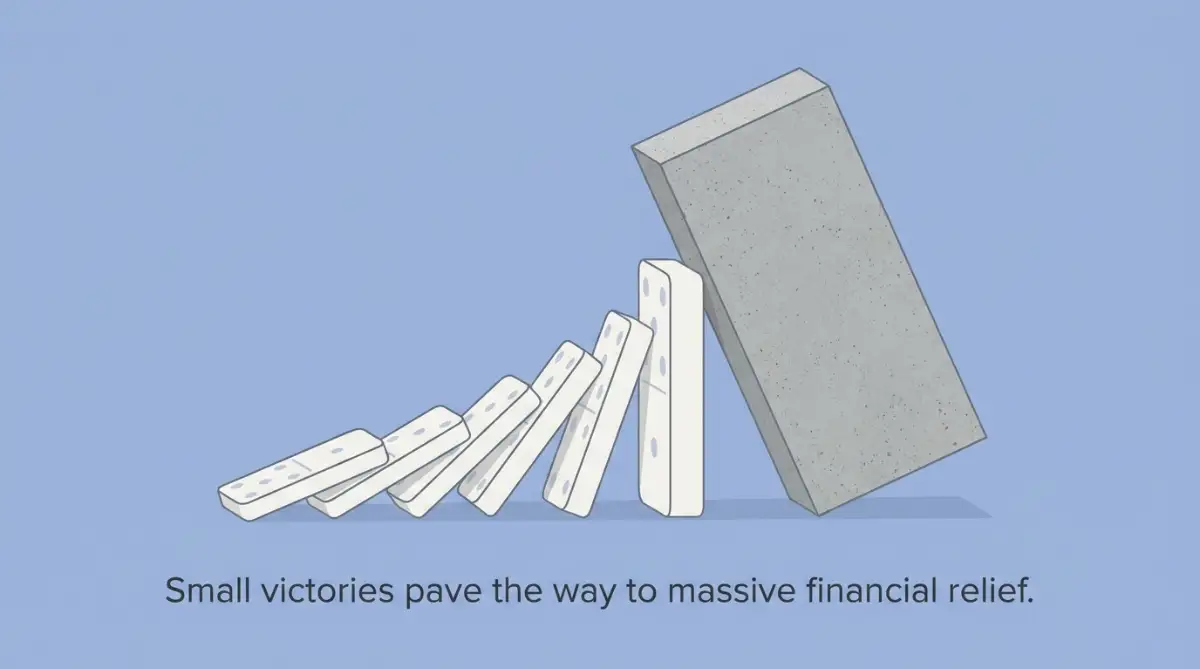
We are emotional creatures driven by motivation, habit, and hope. This is where the Debt Snowball method changes the entire game.
Code
[Your Debt List] ➔ [Pay Smallest First] ➔ [Quick Victory] ➔ [Dopamine Boost] ➔ [Momentum to Pay Bigger Debts]
When you pay off a small bill completely, your brain gets a sudden rush of satisfaction.
This quick win releases a chemical called dopamine, which makes you feel happy and successful.
That small victory proves to your subconscious mind that you actually can win this fight.
Suddenly, the impossible mountain looks a little bit smaller.
You no longer feel like a victim of your past mistakes; you feel like an active player in your own rescue.
This psychological shift is the secret engine that powers long-term financial recovery.
Myth vs. Reality: The Human Side of Debt
The Mathematical Myth The Psychological Reality You must always pay the highest interest rate first to save the most money. If you do not see quick progress, you will lose hope and quit entirely. Budgeting is purely about numbers and strict spreadsheets. Budgeting is about managing human behavior and building positive habits. Debt is a sign of poor intelligence. Debt is often a result of lack of tools, unexpected emergencies, and systemic pressure.
Your Step-by-Step Guide to Rolling the Snowball
To start this journey, you do not need complicated software or an expensive financial planner.
You only need a pen, a piece of paper, and the willingness to take a honest look at your situation. Let us break down exactly how to start this process today.
Step 1: The "No-Judgment" Inventory
First, gather every single one of your statements and list your debts from the smallest balance to the largest balance.
Do not look at the interest rates for this step.
Whether a card has a 29% interest rate or a 5% interest rate does not matter right now.
Write down the name of the lender, the total amount you owe, and the minimum monthly payment.
For example, your list might look like this:
- Medical Bill: $300 (Minimum payment: $15)
- Credit Card A: $1,200 (Minimum payment: $35)
- Car Loan: $8,000 (Minimum payment: $250)
Seeing all these numbers on one page can feel scary at first.
But remember, you cannot fight an enemy that you refuse to look at.
Once this list is on paper, you have officially taken back control.
Step 2: The Minimum Payment Guard
Now, set up automatic payments to pay the minimum amount on every single debt on your list, except for the smallest one. This step is critical because it keeps your account standing clean and stops late fees. It acts as a shield, protecting your credit score from further damage while you focus your energy.
Many people make the mistake of trying to pay a little bit extra on all their cards at the same time.
This spreading of resources is like throwing cups of water on five different fires; none of them actually go out.
By keeping everything else at the minimum, you free up your financial power for a concentrated attack.
Step 3: Finding Your Extra Spark
To make the snowball roll faster, you need to find extra cash to throw at your smallest debt.
Look closely at your daily habits to see where your money is quietly leaking away.
Small, unnoticed expenses can add up to a significant amount over thirty days.
The Quick Subscription Audit
Log into your bank account and check your recurring payments.
Are you paying for streaming services, app subscriptions, or gym memberships you do not use?
Canceling just two unused services can easily free up $30 a month for your snowball.
The Home Cooking Challenge
Eating out is one of the fastest ways to drain your wallet.
Try preparing your meals at home for just two weeks.
The money you save on restaurants can go straight toward wiping out that first small bill.
Every single extra dollar you find should be added to the minimum payment of your smallest debt.
If your smallest debt is a $300 medical bill with a $15 minimum, and you find an extra $50, you are now paying $65 a month on that bill.
In less than five months, that medical bill will be completely gone.
Step 4: The Momentum Shift
When that first small debt is finally paid off, do not use that extra money to buy something new.
Instead, take the entire amount you were paying on that debt and add it to the minimum payment of the next smallest debt.
Using our previous example, once the medical bill is gone, you take that $65 and combine it with the $35 minimum of Credit Card A.
You are now paying $100 a month toward Credit Card A.
You did not have to find new money; you simply redirected your old payments.
Code
[Medical Bill Paid!] ➔ [Transfer $65] + [Credit Card A Minimum $35] ➔ [New Total: $100/month for Credit Card A]
This is why it is called a snowball.
As you move down your list, your monthly payment on the active debt gets larger and larger.
By the time you reach your biggest loans, you have a massive financial hammer to smash them to pieces.
Pro Tip: Celebrate the Small Milestones
When you cross a debt off your list, take a moment to celebrate. You do not need to spend money to do this. Share the good news with a trusted friend, enjoy a relaxing walk, or watch your favorite movie. Rewarding your brain for these milestones strengthens your positive habits and keeps you motivated for the next challenge.
Overcoming the Psychological Friction of the Journey
On this path, you will likely face moments of doubt. You might look at your friends online buying new things and feel a sense of missing out. It is important to remember that social media only shows a highlight reel, not the real financial struggles behind the scenes.
Many of those people buying luxury items are doing so with high-interest debt.
They are trading their future peace of mind for temporary status.
You are doing the exact opposite; you are sacrificing a little bit of temporary comfort to buy your permanent freedom.
If you make a mistake and overspend one week, do not throw away your entire plan.
Forgive yourself, learn from the slip-up, and get right back on track the very next day.
This journey is not about being perfect; it is about making consistent progress over time. To sum up, the debt snowball works because it respects your humanity.
Keeping the Wheel Turning: Advanced Strategies for High-Velocity Debt Payoff
Once your initial snowball is rolling, you can use advanced techniques to make it move even faster.
These expert-level strategies are designed to keep you motivated while shaving months, or even years, off your debt-free timeline.
To make the most of your efforts, you must learn how to handle unexpected financial windfalls.
Many people view tax refunds, work bonuses, or cash gifts as "free money" to be spent on luxury items.
Instead, try treating at least eighty percent of every windfall as an extra-strong push for your active snowball.
Another powerful strategy is to negotiate directly with your creditors to lower your interest rates.
Most people do not realize that a simple, polite phone call can lead to a temporary or permanent rate reduction.
According to reports from the Consumer Financial Protection Bureau, interest rates and fees make up a massive portion of what keeps consumers trapped in cycle-based debt.
You can call your card issuer and use a simple script to ask for relief.
Tell them you have been a loyal customer but are currently looking at options to consolidate your debt due to high rates.
Often, the customer retention department will offer you a lower rate just to keep your account open.
Code
[Call Bank] ➔ [Mention Debt Consolidation Options] ➔ [Ask for Rate Review] ➔ [Lower Interest Approved]
If you have a large number of high-interest accounts, managing multiple payments can become mentally exhausting.
In such cases, you might want to look into consolidating multiple debts safely to simplify your monthly plan.
This helps group your obligations so you can focus your mental energy on a single, clear target.
Building Your Financial Shield
While you are pushing hard to clear your bills, you must protect your progress from unexpected emergencies.
If you throw every single dollar at your bills without saving anything, you leave yourself exposed to sudden disasters.
A flat tire or a medical bill could easily force you back into using credit cards.
This is why building a solid emergency fund is an essential part of any successful debt-free plan.
Having even a small cash buffer of one thousand dollars acts as a buffer between your life and financial chaos.
It ensures that when things go wrong, you can pay with cash instead of sliding back into debt.
Harnessing the Momentum of Your Budget
To keep your momentum high over the long term, you need to track your progress visually.
Create a simple chart and place it on your refrigerator or bathroom mirror where you will see it every day.
Coloring in a bar chart as your balances drop provides a physical sense of accomplishment that keeps your brain engaged.
You should also automate your payments as much as possible to protect yourself from human error.
Set up automatic transfers from your checking account on the exact day you get paid.
This removes the pain of manually paying bills and ensures you never accidentally miss a payment deadline.
Do's and Don'ts for Long-Term Success
- Do review your bank statements at the end of every week to catch tiny spending leaks.
- Do celebrate your victories with zero-cost rewards like a night in with your favorite movie.
- Don't increase your spending habits as soon as your smallest credit card is paid off.
- Don't hide your financial goals from your family; support from loved ones makes the journey easier.

Dangerous Missteps That Drain Your Momentum
Even the most dedicated people can stumble on their way to financial freedom by making simple, avoidable errors.
These mistakes act like quiet leaks in a boat, slowly draining your energy until you feel like giving up entirely.
Understanding these traps beforehand is the best way to ensure you do not fall into them.
The most common trap is what experts call the "Reward Trap."
When you pay off your first small bill, the feeling of relief can make you want to celebrate by buying something expensive.
This is highly dangerous because it reintroduces the very spending habits that caused the initial financial stress.
Another critical error is neglecting your basic safety net while focusing too much on your debt.
Without a cash reserve, you are only one car breakdown away from feeling completely defeated.
If you have to borrow money again to cover an emergency, the psychological blow can make you abandon your entire plan.
Code
[No Emergency Fund] ➔ [Unexpected Expense Hits] ➔ [Borrow Money Again] ➔ [Loss of Hope] ➔ [Quitting the Plan]
Additionally, you must avoid the temptation to skip or delay your payments, even when money is tight.
If you find yourself missing a personal loan EMI payment, the resulting late fees and credit damage can quickly erase months of hard work.
Consistency is far more important than the size of your extra payments.
Finally, be highly cautious of quick-fix financial products that promise to solve all your problems overnight.
Many people make the mistake of getting approved for a personal loan with bad terms just to pay off their credit cards.
Without changing your daily spending habits, this only shifts your debt from one place to another while adding new fees.
Research from institutions like the Harvard Business School Working Knowledge shows that behavioral change is the single most important factor in debt reduction.
If you do not change how you relate to money, no amount of financial restructuring will save you.
Focus on changing your daily actions rather than looking for a magical shortcut.
Your Action Plan: Stepping Into a Lighter Financial Future
The journey to financial peace does not require giant leaps; it is built on small, daily choices.
You do not have to live under the shadow of financial anxiety forever.
By choosing the snowball method, you are choosing a path that works with your brain, not against it.
Your Action Checklist for Tomorrow Morning
To help you take immediate action, here is a simple checklist you can complete tomorrow morning:
- Log into your accounts and list your debts from the smallest balance to the largest.
- Set up automatic minimum payments for every debt on your list except the smallest one.
- Identify one unused subscription or streaming service and cancel it immediately.
- Transfer the money saved from that canceled service directly toward your smallest debt.
- Create a simple paper tracker to visually mark off your progress as you pay down your bills.
Remember that the hardest part of any journey is simply taking the very first step. Do not let the total size of your debt mountain keep you from starting today. Each small payment you make is a vote for the person you want to become.
You deserve to live a life free from the constant weight of unpaid bills and collections calls. You deserve to have calm, peaceful nights of sleep without financial worry running through your mind.
The power to change your story is entirely in your hands, so take that first step and watch your snowball grow.
Disclaimer
This article is for educational and informational purposes only and should not be taken as professional financial, legal, or tax advice. Personal finance situations vary greatly, and you should consult with a certified financial planner or professional advisor before making any major financial decisions.