

The Hidden Gaps in Your Funding: When a Simple Typing Error Costs Thousands
One typo on a financial aid form can zero out thousands of dollars in college funding, and most families never see it coming. The federal system runs on automated checks that don't forgive small mismatches, whether it's a misreported retirement account or a name that doesn't match your social security card exactly. Here's where those silent errors actually hide, so a simple mistake doesn't cost you your tuition.
The Errors That Silently Zero Out Your Aid
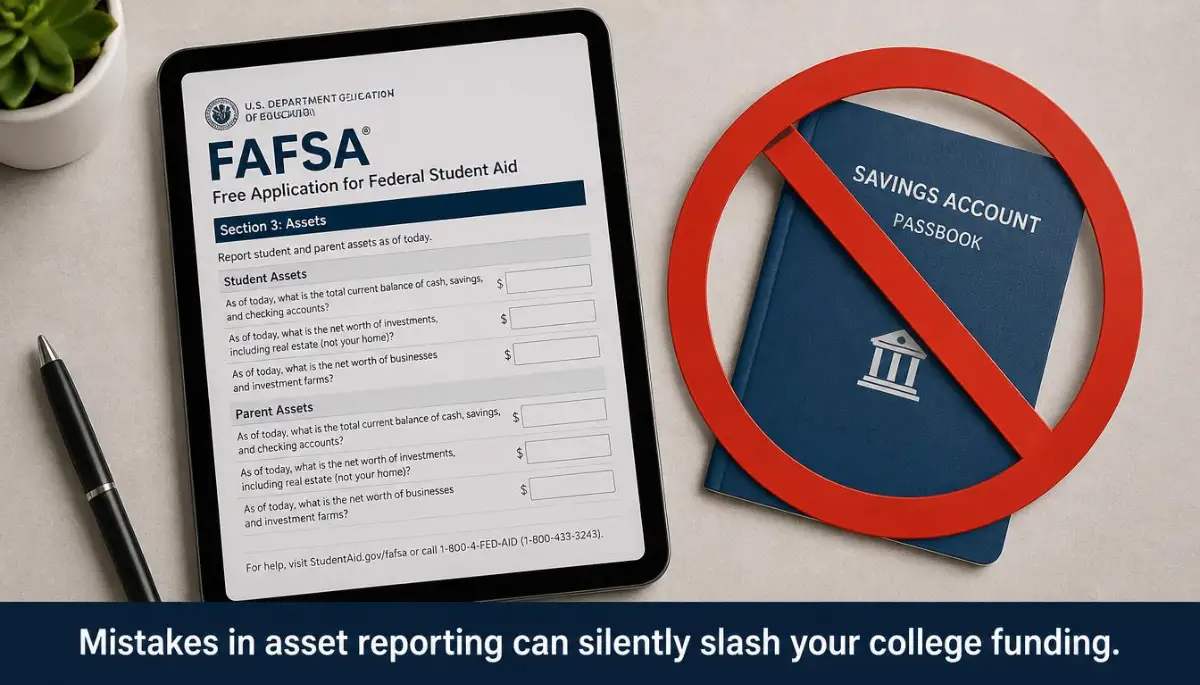
- Retirement accounts (401k, IRA, pension) should never be reported as assets, doing so can wipe out need-based grants entirely.
- Your name, birthdate, and social security number must match your official documents exactly, or your application gets flagged for manual review.
- College-aged siblings supported by your parents count toward household size, even if they live away at school.
- State and institutional grants often run out on a first-come, first-served basis, filing early matters as much as filing correctly.
Sifting Through the Paperwork: Unmasking Hidden Financial Aid Errors
To protect your college funding, you must understand that the federal aid application is not a simple sign-up sheet.
The government uses your submitted data to calculate your Student Aid Index, which determines exactly how much assistance you receive.
We need to look closely at the most important areas of the application so you can identify serious issues before they ruin your academic budget.
The Asset Reporting Pitfall: Keeping Retirement Funds Protected
The most common and expensive mistake students make is reporting assets that are legally exempt from the federal aid calculation.
When the form asks for your family's total investments and savings, many parents mistakenly include the value of their retirement accounts.
This includes protected funds like a 401(k), traditional IRA, Roth IRA, or pension plans.
Under federal guidelines, the value of your primary home and your qualified retirement accounts should never be reported as investments.
If you accidentally list these protected balances, the automated system will assume your family has ample liquid cash to pay for college.
As a result, your eligibility for need-based grants, such as the Federal Pell Grant, will be slashed to zero.
Always double-check the asset definitions before entering any numbers on your application.
Keep your retirement savings completely separate from your general savings and investment balances.
Taking this step ensures that your parents' long-term security is protected while you receive the maximum aid you qualify for.
Q: What about a 529 college savings account, does that count as an asset?
A: Yes, unlike retirement accounts, a 529 plan owned by a parent does count as a reportable asset, though it's assessed at a much lower rate than regular savings. Don't confuse it with a 401(k) or IRA, those stay off the form entirely.
The Double-Check Protocol for IRS Data Transfers
Using the built-in tax transfer tool is the fastest way to populate your financial aid forms.
However, you must ensure that your personal identification details match your official tax records perfectly.
Want to see a step-by-step screen walk-through of how to safely link your tax documents without triggering system flags? Watch this quick, expert video guide before reading about asset reporting errors below!
The Name-Match Lock: Syncing Your Personal Details Perfectly
The automated systems that process federal aid are incredibly sensitive to minor typos in your personal identification details.
If your name on your social security card includes your middle initial, but you leave it off your aid application, the system will flag your account.
This simple mismatch will halt your application immediately, forcing you into a lengthy manual verification process.

The same rule applies to your date of birth, home address, and social security number.
Ensure that every single character matches your official government documents perfectly before clicking submit.
If your parents have different last names due to marriage or divorce, double-check that their details are entered correctly as well.
Taking these precautions will prevent your application from being delayed during peak processing weeks.
It keeps your file moving smoothly through the system so your aid check arrives before your tuition deadline.
Myth vs. Reality: Federal Student Aid Expectations
| Common Financial Aid Belief | The Cold Academic Reality |
|---|---|
| Only low-income families qualify for federal loans and grants. | Families of almost all income levels qualify for some form of federal aid, including low-interest loans. |
| You need perfect grades to receive any financial assistance. | Most federal aid is based on financial need, not GPA or test scores. |
| Once approved, your aid amount stays the same for all four years. | You must reapply every year, and your aid adjusts based on current income. |
Pro-Level Realization: The Manual Entry Mistake
I once tried to type in my parents' tax information manually because the direct data link tool was having a temporary error. I ended up reversing two numbers on our gross income, which instantly triggered an audit and delayed my aid check for three months. My advice is to wait out any system glitches and always use the official IRS data transfer tool to avoid human typing mistakes.
The Household Size Calculation: Defining Your Family Correctly
Calculating your household size seems like a simple task, but the federal guidelines have very specific rules.
Under standard guidelines, your household size includes any siblings who receive more than half of their financial support from your parents.
This applies even if those siblings do not live in the same house, such as a brother or sister who is away at college.
If you leave these college-aged siblings off your application, you are making a massive mistake that will reduce your aid.
The system assumes your parents only have to support one student, making your family look financially stronger than it actually is.
Always include every dependent sibling to ensure your family's financial burden is represented accurately.
You should also check if your grandparents or other relatives qualify as dependents under the official guidelines.
If your parents provide more than half of their financial support, they should be included in your household size.
This simple adjustment can significantly increase your eligibility for need-based grants and work-study programs.
Here's what this looks like in a real family: two siblings, one at your kitchen table and one away at a different university. Leaving that second sibling off the form makes it look like your parents only support one student, when in reality they're splitting the same income two ways, and your aid calculation should reflect that.
Typical Funding Impact: Error-Free vs. Incorrect Applications
To help you understand the real financial impact of these mistakes, let us compare the funding outcomes of typical application profiles:
| Application Status | Standard Need-Based Grant Payout | Low-Interest Federal Loan Eligibility |
|---|---|---|
| Error-Free Application | $7,395 (maximum Pell Grant approved) | $5,500 (subsidized federal loans secured) |
| Incorrect Asset Reporting | $0 (exempt retirement funds reported as cash) | $0 (ineligible for subsidized options) |
| Mismatched Social Security Name | $0 (application suspended for manual audit) | $0 (processing delayed past deadline) |
| Incorrect Household Size | $2,500 (sibling away at college left off form) | $3,500 (reduced subsidized loan limits) |
The Deadline Disaster: Submitting Your Forms Too Late
While the federal government has a very late deadline for submitting your aid application, individual colleges have much earlier priority deadlines.
Many state-based grant programs operate on a first-come, first-served basis, meaning the money runs out quickly.
If you wait until the last minute to submit your forms, you are making a devastating mistake.
Even if you qualify for state grants, you will receive nothing if the state's funding pool has already been emptied.

Submit your application the exact moment the filing window opens to secure your share of these limited funds.
You should also check the specific priority deadlines for every college you are applying to.
Some schools require you to submit your federal aid forms as early as December to qualify for their private scholarships.
Keep a detailed calendar of these key dates to ensure you never miss out on free college money.
Coordinating Your Funding Shield with Smart Financial Habits
Securing your federal aid is only the first step to protecting your financial future.
Once you receive your aid package, you must manage your money with extreme discipline to avoid falling into deep debt.
If your federal aid does not cover your entire tuition, you may need to look for alternative funding options.
Before you borrow any money from private lenders, make sure you are identifying hidden personal loan fees to protect your budget from predatory lending practices.
Many private lenders use confusing terms to hide expensive processing and origination charges from young students.
Understanding these details is an important step to keeping your student debt as low as possible.
You should also avoid the temptation to use credit cards to cover your daily college living expenses.
If you carry a balance on your cards, the high interest will quickly compound, turning a small debt into a major financial emergency.
Spend time understanding the true cost of credit card interest to see how paying only the minimum monthly amount can keep you trapped in debt for decades.
Harnessing these smart financial habits early in life will protect your income and give you a massive head start after graduation.
To protect your family's overall financial health, you should also look at evaluating home insurance coverage limits to shield your home from sudden disasters.
A well-protected household budget ensures that your parents will not have to divert their income from your college fund to cover unexpected property repairs.
Keep your academic records, tax files, and financial documents stored in a secure, private place.
Always remember that why free cloud drives threaten your privacy is a key issue when handling sensitive financial data.
Use secure, offline encrypted folders to protect your private documents from data leaks and identity thieves.
Your Pre-Submission Checklist for Federal Aid
Before you click the submit button on your application, run through this simple checklist to protect your funding:
- Verify that your name, date of birth, and social security number match your official social security card perfectly.
- Double-check that your parents' retirement accounts (401k, IRA, pension plans) are completely excluded from your reported assets.
- Confirm that your primary home equity is not reported as an investment on the form.
- Include all dependent siblings who receive more than half of their support from your parents, even if they are away at college.
- Use the official IRS data transfer tool to automatically link your family's tax details without typing them manually.
- Research and record the exact priority financial aid deadlines for every college on your application list.
By running through this checklist, you show that you are an active, informed student who knows how to navigate the system.
A tiny mistake can delay your funding for months, so take your time and verify every single line.
Your academic future deserves this careful attention to detail, so protect your funding and submit with absolute confidence.
Next-Level Hacks: How to Navigate Advanced Aid Options and Protect Your Package
When you are working to secure your college funding, simply submitting your basic application is only the first step.
Many families do not realize that the initial aid package sent by a college is often not their final offer.
To protect your academic budget, you must learn how to use advanced strategy steps to maximize your federal and state assistance.
One of the most powerful moves you can make is to understand the Professional Judgment Appeal process.
If your family has experienced a major financial change since your last tax filing, you can ask for a formal review.
Job losses, unexpected medical bills, or sudden natural disasters can make your past tax documents completely inaccurate.
To start this process, contact the financial aid office at your target college directly and request a professional judgment review.
You must provide clear, physical documentation to prove your current financial hardship, such as termination letters or medical bills.
According to guidelines from the Federal Student Aid official portal, college financial aid administrators have the legal authority to adjust your aid eligibility based on these unique family circumstances.
Taking this step can unlock thousands of dollars in extra need-based grants, saving you from taking out expensive private loans.
It ensures that your current financial reality is represented accurately, keeping your academic dreams alive during tough times.
The Day One Filing Advantage: Securing Limited Funding Pools
Many state-based grant programs and institutional scholarships operate on a first-come, first-served basis.
This means that even if you qualify for these limited funds, you will receive nothing if the state's funding pool is already empty.
To protect your package, you must make a habit of submitting your federal aid application the very first day the filing window opens.
Filing early gives you a massive advantage over other applicants who wait until the spring deadlines.
It ensures your file is processed first, securing your share of state-based grants before the resources are completely exhausted.
According to industry reports from the NASFAA industry reports, early applicants consistently receive larger overall aid packages than those who submit their forms late.
Never let procrastination rob you of free college money.
Set a recurring reminder on your calendar, gather your tax documents early, and submit your application on day one.
Securing Your Academic Shield with Smart Family Planning
Protecting your college funding also requires you to coordinate your academic plans with your family's overall financial security.
If your parents face a sudden property disaster, they might be forced to spend your college savings to cover the repairs.
This is why taking the time for evaluating home insurance coverage limits is an important part of protecting your family's financial base.
Having the right insurance limits ensures that your home can be rebuilt after a storm without draining your college fund.
It acts as a critical second layer of protection, shielding your academic journey from unexpected physical property damage.
It keeps your family from having to choose between fixing a leaking roof and paying your tuition bill.

Silent Landmines: The Psychological Errors That Blind Financial Aid Applicants
When we are excited to head to our dream college, our emotions can easily cloud our logical decision-making.
Lenders, colleges, and private aid search engines often use this emotional excitement to push expensive financial products onto young students.
Recognizing these psychological traps is key to maintaining your financial safety during the application process.
The Myth of Making Too Much Money
The most common mistake families make is assuming they will not qualify for any federal financial aid because of their income.
Many middle-income parents decide to skip the federal application entirely, believing it is a waste of their time.
This is a devastating mistake that can lock you out of thousands of dollars in low-interest federal loans.
Even if you do not qualify for need-based grants, submitting the federal form is often required to qualify for institutional scholarships and work-study programs.
Furthermore, federal student loans offer much better borrower protections and lower interest rates than private bank loans.
Never self-reject your family before letting the official government systems calculate your actual eligibility.
The Danger of Confusing Federal Aid with Private Student Loans
When you receive your financial aid award letter from a college, the total offer can look incredibly generous.
Lenders and schools often bundle federal grants, work-study, and high-interest private loans into a single "awards" package.
If you do not read the fine print, you might assume that your entire tuition is covered by free government aid.
Always separate the free money (grants and scholarships) from the borrowed money (loans) on your award letter.
If you must borrow money to cover the gap, be extremely cautious when dealing with private lenders.
Take the time for identifying hidden personal loan fees to ensure you are not being trapped by predatory terms and high origination charges.
If you do not have a solid plan to manage your student debt, you run the risk of carrying a heavy financial burden for decades.
This is why understanding the true cost of credit card interest is so important when managing your daily college budget.
Avoiding high-interest debt early in life is the single fastest way to secure your financial independence after graduation.
Treating the Financial Aid Process as a One-Time Task
Some students assume that once their freshman financial aid is approved, their funding is guaranteed for their entire college career.
This is a dangerous misconception that can lead to a sudden financial crisis during your sophomore year.
Your family's financial situation, income levels, and household size can change from year to year, directly affecting your aid eligibility.
You must submit a brand-new federal financial aid application every single year you are enrolled in college.
If your sibling graduates from college or your parents earn more money, your aid package will adjust accordingly.
Keep a detailed record of your yearly filing dates to ensure you never miss a deadline and lose your funding.
According to policy updates from the U.S. Department of Education policies, failing to submit your renewal application on time is a leading cause of accidental aid loss.
Never let your policy sit on autopilot; treat your yearly financial aid renewal like a mandatory academic exam.
Failing to Monitor Your Application Status
Many students submit their federal aid application and assume the process is completely finished.
However, the government selects about thirty percent of all applications for a random auditing process called verification.
If your application is selected, your college's financial aid office will request additional documents, such as tax transcripts, to verify your details.
If you ignore these requests or miss the submission deadlines, your financial aid package will be completely canceled.
Always check your college student portal and your personal email address at least once a week for any urgent verification alerts.
If your aid package is delayed or denied due to a missed deadline, you can look at disputing denied insurance claims to see how to write a formal appeal letter to resolve disputes.
Your Academic Funding Blueprint: Tomorrow's Action Plan
Achieving a secure, fully-funded college education does not require you to be a financial genius.
It is built on a series of small, consistent habits that protect your academic budget from unnecessary gaps.
Your Immediate Action Checklist
Here is a simple checklist you can implement starting tomorrow morning to protect your college funding:
- Log into your portal: Check your primary student portal for any urgent financial aid verification alerts.
- Review your tax transcripts: Ensure your family's tax records are easily accessible for the upcoming filing season.
- Create your FSA ID: Set up your official Federal Student Aid identification credentials using a secure personal email address.
- Mark priority deadlines: Research and record the exact priority financial aid deadlines for every college on your list.
- Audit your investments: Confirm that your parents' qualified retirement accounts are excluded from your reported assets.
By taking these small, deliberate steps, you are shifting from a passive applicant to an active manager of your academic future.
You will feel a deep sense of confidence knowing that your college funding is safe behind real administrative armor.
Taking charge of your financial aid is an indispensable step to building a peaceful, secure life.
I still remember the feeling of relief when I finally received my fully approved aid package, knowing my tuition was completely covered.
Let us take action tomorrow morning, complete our checklists, and build a solid shield around our largest academic investment.
Critical Questions Every Student and Parent Asks
How does my household size affect my federal aid package?
Your household size directly affects your Student Aid Index calculation. A larger household size tells the government that your parents must divide their income to support more dependents, which significantly increases your eligibility for need-based grants.
Can I apply for federal aid if my parents are divorced?
Yes, you can absolutely apply for federal aid if your parents are divorced. Under the latest federal guidelines, you must report the income and assets of the parent who provided the most financial support over the past twelve months.
What should I do if my financial aid application is selected for verification?
If your application is selected for verification, do not panic, as this is a very common random audit. Quickly gather the requested tax transcripts and household verification forms, and submit them to your college's financial aid office before the priority deadline.
Can I receive federal financial aid if I attend college part-time?
Yes, you can qualify for federal aid even if you are enrolled in college part-time. However, your total grant amounts and loan limits will be adjusted proportionally based on your actual credit hour enrollment.
Disclaimer:
This article is for general informational and educational purposes only and does not constitute professional financial, academic, or legal advice. Financial aid eligibility, state grant guidelines, and institutional scholarship requirements vary greatly by college, state, and individual circumstances. Always consult with a licensed college financial aid counselor or professional academic advisor before making major decisions regarding student loans or college funding contracts.