
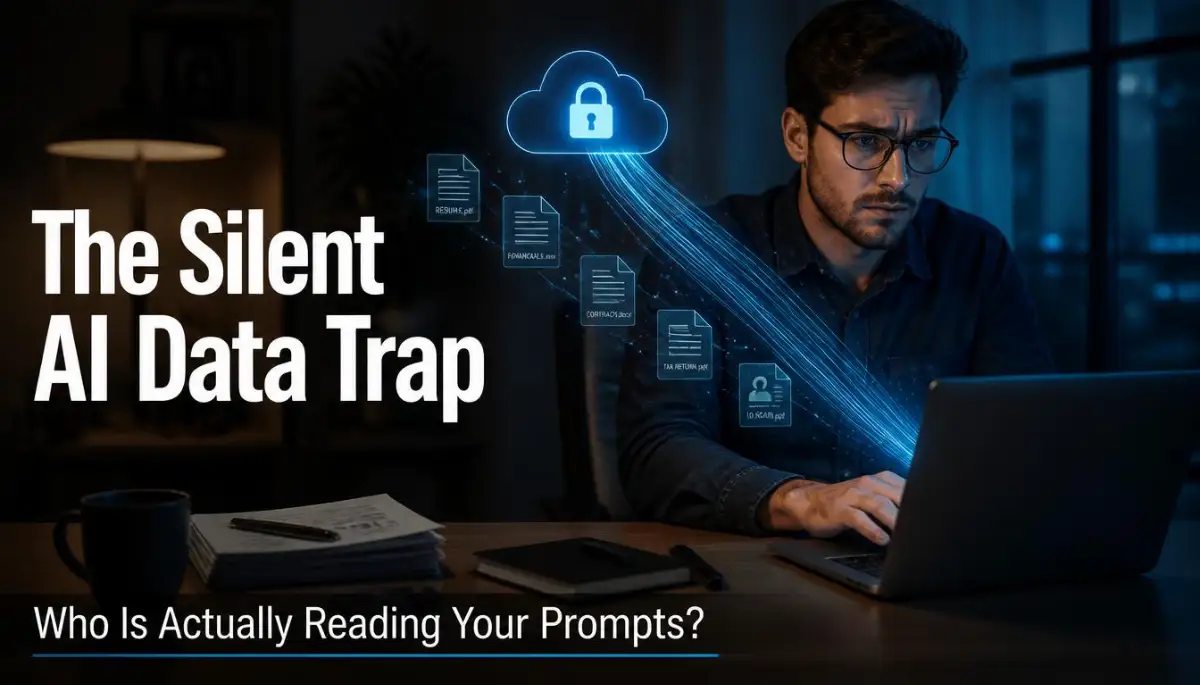
The Innocent Chat That Turned Into a Nightmare
I still remember the exact afternoon I realized how much of my private life I was giving away. I was sitting at my kitchen table, completely overwhelmed by a massive stack of medical bills and insurance letters. In a desperate attempt to organize everything, I opened a popular free AI chatbot and copy-pasted the entire messy document into the text box.
I asked the bot to summarize my medical codes and outstanding balances. It did an absolutely brilliant job, saving me hours of frustrating math. But later that night, I was reading an article about how these specific tech companies handle user input, and my stomach completely dropped.
I suddenly realized I had just uploaded my full legal name, my home address, and my private health conditions directly into a massive, public machine learning database. I felt a cold wave of panic wash over me as I scrambled to find the "delete" button, only to realize the data had already been processed.
Millions of people make this exact same innocent mistake every single day. The technology is so incredibly helpful and conversational that we completely forget we are talking to a giant corporate server. We treat these bots like private therapists, trusted financial advisors, or personal assistants.
People are pasting sensitive work emails, unreleased business plans, and even their children's report cards into these public chat boxes. The emotional relief of getting instant help completely blinds us to the massive privacy risks we are taking. When you finally realize that a faceless corporation might own a permanent copy of your deepest secrets, the anxiety is absolutely suffocating.
You start wondering if your confidential work project is going to suddenly appear in someone else's search results next week. It feels like you accidentally left your personal diary open on a table in a crowded coffee shop. The guilt and fear of identity theft or professional ruin constantly hang over your head.
We blindly trust these clean, minimalist chat interfaces because they look safe and friendly. However, the reality of how artificial intelligence handles your private thoughts is incredibly complicated and quite terrifying. Let us pull back the curtain on this hidden system so you can protect your digital identity starting today.

Quick Summary: The Reality of Your Prompts
- You Are the Training Material: Free AI tools actively use your chat history to teach their massive language models how to write better.
- The "Delete" Button is a Myth: Even if you delete a chat, your pasted text might have already been permanently baked into the algorithm.
- Human Eyes Are Watching: Tech companies often hire human reviewers to read random chat logs to ensure quality control.
- Opt-Out is Your Best Friend: You must manually dig into the settings menu to force the bot to stop learning from your specific account.
Decoding the Brain of a Public Language Model
To understand why your data is in danger, we have to look at how these massive programs actually get so smart. A Large Language Model (LLM) is not a simple search engine that pulls answers from Wikipedia.
It is essentially a massive, hungry brain that needs to consume billions of words to understand human language. The engineers originally fed it books, articles, and websites to teach it basic grammar.
But to make the bot sound incredibly natural and conversational, it needs fresh, real-world dialogue. The most valuable training material on the planet is the exact conversation you are having with it right now.
When you use a free, public AI generator, you are unknowingly paying for the service with your personal data.
The Permanent Ink of Machine Learning
When you type a private message to a friend on a secure app, that message is encrypted and eventually deleted. Artificial intelligence does not work like a normal messaging app.
When you paste a confidential business contract into a prompt box, the machine breaks your text down into mathematical tokens. These tokens are permanently baked into the underlying neural network to improve its future responses.
Think of it like mixing a drop of blue food coloring into a massive swimming pool. Once the blue drop mixes with the water, you cannot just reach in and pull it back out.
Even if you click the tiny trash can icon next to your chat history, the actual algorithmic knowledge the bot gained from your text remains inside the machine forever.
The Risk of Accidental Data Leaks
Because your private data becomes part of the permanent training pool, it creates a terrifying new vulnerability. These language models are designed to generate text based on patterns they have seen before.
If you feed the bot your company's secret financial projections, the bot learns those specific numbers. Next week, a rival business owner might ask the exact same bot a highly specific question about your industry.
Because the bot relies on the patterns you gave it, it might accidentally spit your confidential numbers out to your competitor. This is not a theoretical fear; massive global corporations have already fired employees for accidentally leaking proprietary source code into public chat interfaces.
I actually made a terrible mistake early on by asking an AI to proofread a highly sensitive client proposal before I sent it out. I did not realize until months later that the client's private marketing strategy was technically floating around in an open-source training database. That terrifying realization completely changed how I handle client confidentiality in the modern digital age.
Before we look at the sneaky ways companies hide these rules, watch this incredibly eye-opening video that explains exactly how language models memorize your secrets.
The Human Reviewer Loophole
There is a very common misconception that artificial intelligence is completely automated and robotic. We assume that because we are talking to a machine, no actual human being will ever read our embarrassing questions.
This assumption is dangerously incorrect. To make sure the bot is not generating toxic or harmful content, massive tech companies employ thousands of human quality-control workers.
These human workers randomly select and read thousands of user chat logs every single day. They read your prompts, analyze the bot's response, and grade the interaction to help the system improve.
If you paste your social security number or a private love letter into the chat, a random contractor sitting in an office halfway across the world might be reading it right now.
Interactive Markdown Table: Safe vs. Dangerous Inputs
It is very easy to forget the rules when you are rushing to finish a project. Let us look at a clear breakdown of what you can and absolutely cannot feed into a public generator.
The "Enterprise" Up-sell Strategy
You might be wondering why tech companies allow these massive privacy risks to exist in the first place. The truth is, it is a highly calculated business strategy.
Companies offer the free, public version of their AI so they can harvest massive amounts of free training data from everyday users. However, they know that big businesses will never accept this level of risk.
To solve the problem they created, they sell an expensive "Enterprise" or "Team" version of the exact same software. If you pay them a high monthly fee, they guarantee a private, locked-down environment where your data is never used for training.
They are essentially forcing you to pay a premium price just to keep your own personal thoughts completely private.
Fighting Back with Data Anonymization
You do not have to stop using these incredible tools entirely. You just need to change how you format your requests before you hit the enter key.
The secret to safe AI usage is a process called data anonymization. Before you paste any document into a prompt box, you must manually strip away all identifying markers.
If you want the bot to summarize a rental agreement, change your real name to "John Doe." Change your actual home address to "123 Main Street," and alter the specific financial numbers slightly.
By using placeholder data, you still get the perfect structural formatting from the AI, but you completely starve the machine of your actual private details. It takes an extra two minutes of manual editing, but it completely neutralizes the threat of a personal data leak.
Mastering Your Artificial Intelligence Boundaries
Changing how you interact with public chatbots does not mean you have to stop using them completely. Professional data analysts and tech experts still rely heavily on these tools every single day to speed up their workflow.
They just use smart, invisible boundaries to ensure their private thoughts never end up in a public training database. You can easily build these exact same protective walls around your own digital life.
Let us explore some highly advanced, yet incredibly simple strategies to keep your private documents completely hidden. These daily habits will give you absolute peace of mind while you work.
The Magic of Using API Connections
If you rely on smart algorithms to do your daily work, you need to stop using the free web browser chat boxes. Instead, you should look into using an Application Programming Interface, commonly known as an API.
An API is simply a secure, direct tunnel between your computer and the company's language model. When you send text through a paid API tunnel, almost all major tech companies guarantee a strict zero-data retention policy.
This means they legally promise not to save your inputs or use your specific text for future algorithm training. You get the exact same brilliant answers, but your private data disappears the moment you close the window.
If you want to discover some safe ai tools that cut your work time in half no tech skills needed, focusing on API-based platforms is the smartest choice you can make. It costs a few pennies per request, but it completely removes the risk of a massive corporate data leak.
Running Local Language Models
The ultimate secret to perfect privacy is taking the brain out of the cloud and putting it directly on your own desk. You do not actually need an internet connection to run a powerful text generator.
You can download open-source models and run them entirely on your local laptop or home computer. Because the software lives physically on your hard drive, your private documents never travel across the internet.
You can feed a local model your private tax returns, confidential client lists, and medical history with zero fear. No giant tech corporation can harvest your data if the data never leaves your physical living room.
According to privacy researchers at the Stanford Institute for Human-Centered Artificial Intelligence, running localized, offline models is currently the gold standard for protecting sensitive enterprise data.
Smart Data Scrubbing Habits
If you absolutely must use a public web interface, you have to become a master of disguise. You should never paste raw paragraphs directly from your personal emails into a chat window.
Instead, you need to build a mental habit of manual data scrubbing. Read through your document and actively replace proper nouns, company names, and specific dollar amounts with generic placeholders.
Change your real company name to "Company X" and alter your exact financial budget slightly. This way, the language model can still fix your grammar and suggest brilliant ideas without ever learning your true identity.
A Quick Do's and Don'ts Checklist
It is incredibly easy to forget your privacy rules when you are rushing to meet a tight deadline. Here is a quick, practical checklist to keep right next to your keyboard.
- DO use an incognito browser window combined with an account that has data training disabled in the settings menu.
- DON'T ask public bots to summarize internal company meeting transcripts or private legal contracts.
- DO replace all sensitive names, addresses, and phone numbers with fake information before pasting text.
- DON'T share your active screen with AI plugins that constantly monitor your daily web browsing habits.

The Tragic Mistakes That Expose Our Digital Lives
Even when we understand the basic privacy rules, human emotions and tight deadlines often force us to make terrible decisions. The sheer convenience of getting instant answers makes us ignore the bright red warning signs.
Many professionals unknowingly compromise their entire career simply because they wanted to finish a project ten minutes early. Let us break down the most dangerous, real-world traps that people fall into every single day.
If you can actively avoid these specific pitfalls, you will easily protect yourself from a devastating privacy disaster.
The Convenience of the Raw Upload
Imagine a stressed human resources manager trying to finish twenty employee performance reviews on a Friday afternoon. In a moment of pure exhaustion, she highlights a massive spreadsheet containing employee names, salaries, and personal medical leave notes.
She pastes the entire block of raw data into a public chatbot and asks it to write nice summary paragraphs. She just unknowingly handed the most sensitive data in her company directly to a public machine learning database.
If the tech company experiences a server breach, those employees' private lives are instantly exposed to global hackers. This is not just a simple mistake; it is a massive violation of trust that destroys entire careers.
You must always remember the dangerous reality of free cloud storage why your files are not safe when dealing with external servers. Any data you send to a free server is basically out of your control forever.
Debugging Private Server Errors
Web developers and website owners make a very specific, dangerous mistake when trying to fix broken code. When a website suddenly crashes, the owner will quickly copy the error logs to find a solution.
These error logs often contain hidden database passwords, secret administrative keys, and exact server locations. If you paste a raw error log into a public text generator to ask for a quick fix, you are giving away the keys to your entire digital house.
A hacker could easily use those exact keys to silently take over your website infrastructure. You absolutely need to know what your server is trying to tell you during a 502 error so you can fix the problem manually without exposing your sensitive server credentials.
Always read through your code and remove the secret passwords before asking a bot for programming help.
Trusting the "Incognito" Illusion
Millions of internet users hold a deeply false belief about how private browsing windows actually work. You might open a dark "Incognito" or "Private" tab on your browser, assuming it makes you completely invisible to the website.
An incognito window only stops your computer from saving your local browser history. It does absolutely nothing to hide the data you actively type into a website.
When you paste your private diary into a chat box using a private window, the tech company still receives and stores every single word. The United States Federal Trade Commission (FTC) frequently warns consumers that private browsing modes do not stop third-party servers from collecting and analyzing your personal inputs.
Never rely on your browser's private mode to protect your sensitive documents from greedy data harvesting algorithms.
Ignoring Sneaky Software Updates
Tech companies are incredibly clever when it comes to gathering more data for their hungry algorithms. Sometimes, you might specifically opt out of data sharing inside your account settings to stay safe.
However, a few months later, the company releases a massive software update with a brand new privacy policy. When you blindly click "Agree" on that update, you might unknowingly reset your privacy choices back to the factory defaults.
Suddenly, your private chats are being actively harvested again without your knowledge. You must deeply understand the 5 hidden dangers of clicking remind me later on system updates to see how quickly your digital protections can vanish.
Make it a strict habit to manually check your privacy settings every single time an application forces you to install a major update.
Your Personal Blueprint for Secure Conversations
You now hold a very powerful understanding of the invisible data machinery operating behind the scenes. The friendly, helpful chatbots you use every day are no longer a mysterious black box.
You know that free public generators treat your private questions, business ideas, and personal struggles as valuable training fuel. You do not have to live with the heavy anxiety of wondering who is reading your confidential text messages.
Your thoughts, your business strategies, and your digital identity are completely yours to protect. By masking your details, using secure API connections, and avoiding raw uploads, you can build a massive wall around your privacy.
You can still enjoy the incredible benefits of modern technology while keeping your secrets locked safely away. When you understand understanding artificial neural networks simply and without equations, you naturally realize why feeding them personal data is so dangerous.
You can comfortably watch how these 5 ways ai assistants are upgrading customer service careers without actually becoming a victim yourself.
I honestly felt a massive wave of relief the day I finally deleted all my old chat histories and turned off the background data sharing options on my accounts. It felt like I was finally taking my own life back from the corporate servers, and you truly deserve to experience that exact same freedom today. Take five minutes right now to check your settings, scrub your data, and completely secure your digital footprint!
Common Questions About Artificial Intelligence Privacy
Does clearing my chat history remove my data from the training pool?
No, it usually does not. Clicking the delete button removes the chat from your personal screen, but the text has likely already been absorbed into the company's permanent machine learning database.
Are paid subscriptions completely safe from data harvesting?
Not always. While premium enterprise accounts usually offer strict privacy guarantees, standard paid subscriptions often still use your data by default unless you manually change your settings.
Can someone else accidentally generate my private secrets?
Yes, this is a known phenomenon called data leakage. If a language model memorizes a highly unique piece of your text, it can occasionally spit that exact text out when a stranger asks a very similar question.
How do I know if an application is using my data secretly?
You have to manually read the company's privacy policy and look for phrases like "improving our services," "algorithm training," or "quality assurance reviews." If you see those words, they are definitely reading your inputs.
Is it safe to use grammar checkers built into my keyboard?
Many modern cloud-based keyboards actively send everything you type back to their servers to improve predictive text. You should carefully review your phone's privacy settings to ensure your keystrokes are staying strictly on your local device.
Disclaimer: The information provided in this article is for educational and informational cybersecurity purposes only. It should not be considered professional legal or IT security advice. Privacy policies for artificial intelligence tools change rapidly, and you should always carefully review the official terms of service for any software before uploading sensitive or confidential information.