

The Airport Counter Panic: When Two Extra Pounds Cost a Fortune
Two pounds. That is often the entire difference between a free checked bag and a hundred-dollar penalty at the airport counter. Most travelers never learn the exact rules until they are standing at the scale, unpacking coats onto the floor in front of a line of strangers. The good news is that every one of these fees is avoidable once you know exactly where airlines draw the line.
Quick Takeaways Before You Pack
- Weigh your checked bag at home; the 50-pound line is strict, and overweight fees start right at 51 pounds.
- Basic economy fares often only include a personal item, not a full carry-on, check your fare class before packing.
- Keep all spare lithium-ion batteries and power banks in your carry-on, never in checked luggage.
- Prepay for checked bags online whenever possible, since gate fees almost always cost more.
Demystifying the Airport Check-In: Navigating Baggage Rules Without Surprise Fees
To protect your wallet at the airport, you must understand that airlines view luggage as a major source of extra revenue.
Airlines split your baggage into very specific categories, each with its own strict dimensions, weight limits, and penalty structures.
Let us explore the core baggage rules every traveler needs to master before heading to the airport terminal.
The Personal Item versus Carry-On Confusion
The most common mistake first-time travelers make is confusing a personal item with a standard carry-on bag.
A personal item is a small bag, such as a purse, laptop backpack, or small duffel, that must fit completely under the seat in front of you.
A carry-on bag is much larger, designed to fit overhead in the storage bins above your seat.
Budget airlines often sell basic economy tickets that only include a free personal item, charging heavy fees if you bring a carry-on to the gate.
If your personal item is too big to slide under the seat, agents will force you to pay an emergency gate-check fee to put it in the cargo hold.
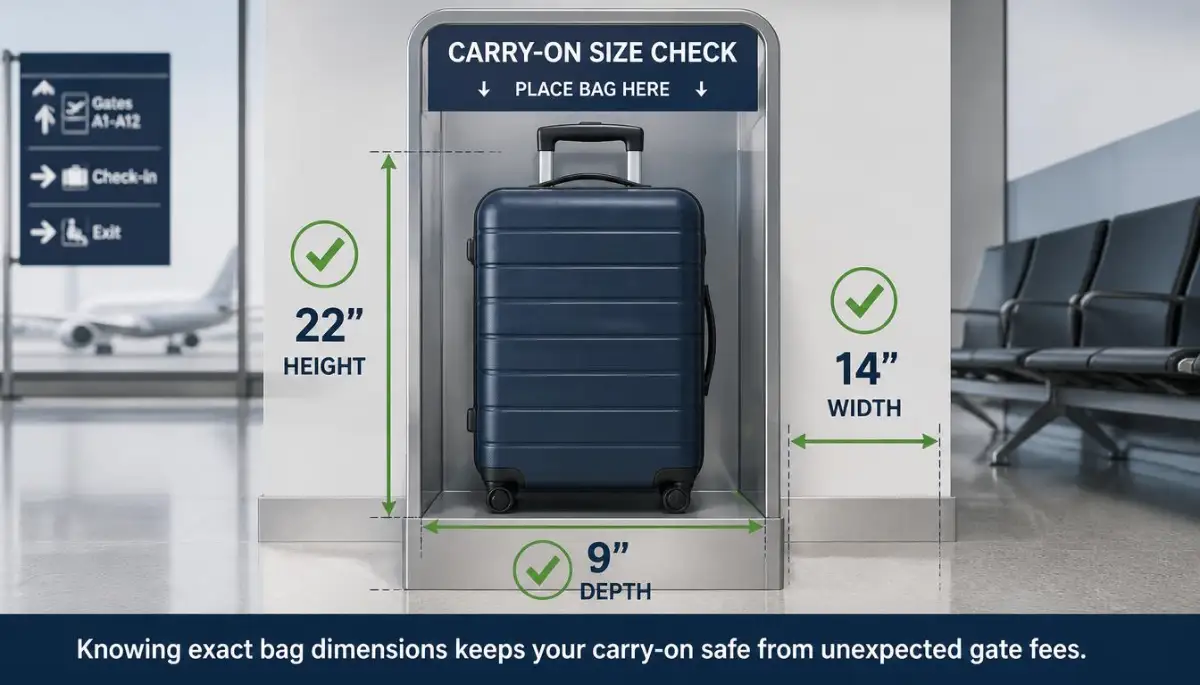
Before you pack, check your airline's exact dimension limits for both personal items and carry-on bags on their official website.
Measure your bag from the wheels to the top handle to ensure it passes the airport sizer test without any issues.
Taking this simple step keeps your bags safe from aggressive gate agents who are trained to spot oversized personal items.
Myth vs. Reality: Airline Baggage Policies
Deciphering Weight and Dimension Formulas: Linear Inches Explained
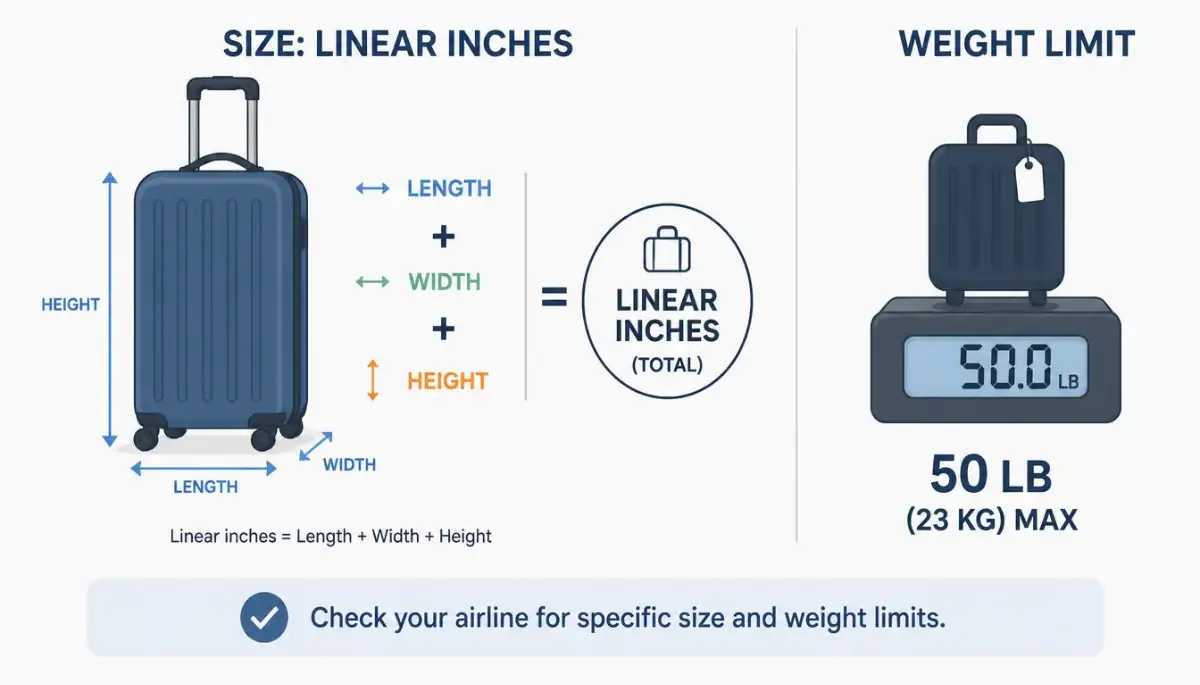
When airlines list their maximum checked baggage sizes, they often use a total measurement called linear inches.
Linear inches are calculated by adding the total length, width, and height of your luggage together into one single number.
For most major international carriers, the standard limit for a checked bag is 62 linear inches (158 centimeters) and 50 pounds (23 kilograms).
If your suitcase measures 63 linear inches or weighs 51 pounds, it enters the oversized or overweight fee category instantly.
Overweight fees are completely separate from standard baggage charges and can easily cost between fifty to two hundred dollars per flight segment.
Quick Fact: Paying for a checked bag at the gate almost always costs more than paying for the exact same bag during online check-in. Airlines price it this way on purpose, so prepaying whenever you can is one of the simplest ways to avoid getting charged the higher counter rate.
Pro-Level Tip: The Portable Scale Shield
I used to pack my bags by guessing their weight on my bathroom scale, which resulted in a massive fee at the airport counter. After that experience, I bought a ten-dollar portable digital luggage scale that hooks directly onto my suitcase handle. Weighing my bags in my hotel room before leaving for the airport has saved me hundreds of dollars in excess baggage fees.
Understanding Code-Share Flights and Interline Baggage Transfers
Flying on a complex route with multiple connecting airlines can create major confusion regarding which baggage rules apply to your ticket.
When airlines partner together on a single booking, it is known as a code-share flight, but each airline may have different size limits.
Under international aviation guidelines, the baggage rules of the Most Significant Carrier (MSC) usually govern the entire journey.
However, if you book separate tickets on different low-cost airlines, you must collect your luggage at the connection point and check it in again.
Want to see a step-by-step screen walk-through of how code-share baggage rules work on multi-airline international itineraries? Watch this quick, expert video guide before reading about restricted carry-on items below!
Comparing Luggage Categories: Dimensions, Weight, and Placement
To help you pack correctly, let us compare the physical rules and placement expectations of standard baggage types:
Unseen Basic Economy Restrictions: The Fine Print Trap
Basic economy fares have become extremely popular because they show cheap ticket prices on flight search engines.
However, these bare-fare tickets strip away standard passenger perks, including the right to use the overhead carry-on bins.
If you purchase a basic economy ticket on certain carriers, you are strictly limited to one small personal item under the seat.
If you bring a standard carry-on suitcase to the boarding gate with a basic economy ticket, the agent will charge you the standard checked bag fee plus an additional gate service penalty.
This double penalty turns a cheap basic economy flight into an expensive ordeal that drains your vacation savings.
Real Traveler Scenario: A family of four booked basic economy fares to save money on their spring break trip. Each person brought a normal-sized carry-on, not realizing their fare only covered a small personal item. At the gate, they paid four separate gate-check fees, wiping out most of what they had saved by choosing the cheaper fare in the first place.
Always read the fare class rules carefully before buying your ticket to confirm what luggage is included in your base price.
Hazardous Materials and Battery Restrictions in Checked Luggage
Packing restricted items in your checked luggage can cause security screeners to open your bags or hold them at the departure airport.
The most common restricted items are lithium-ion power banks, spare phone batteries, and e-cigarettes.
Due to fire safety risks in the cargo hold, all spare lithium-ion batteries and portable power banks must be carried inside your personal item or carry-on bag.
If airport screeners spot a power bank inside your checked suitcase during X-ray scans, they will physically remove it and throw it away.
Similarly, liquids in your carry-on bag must follow the strict 3-1-1 liquids rule—containers must be 3.4 ounces (100ml) or smaller, placed inside one clear quart-sized bag.
Larger liquid containers like full-sized shampoo bottles must be packed securely inside your checked luggage to clear security checkpoints.
Pre-Flight Packing and Baggage Checklist
Before you zip up your bags and leave for the airport, run through this simple checklist to protect your travel budget:
- Measure the length, width, and height of your carry-on bag to ensure it meets your airline's exact sizer dimensions.
- Weigh your checked suitcase using a digital luggage scale to verify it is under the 50-pound (23 kg) weight limit.
- Place all spare lithium-ion power banks, laptop batteries, and e-cigarettes inside your carry-on bag, never in checked luggage.
- Pack all liquids larger than 3.4 ounces (100ml) inside your checked suitcase rather than your carry-on.
- Confirm your fare class restrictions to verify if an overhead carry-on bag is included in your ticket price.
- Attach a durable luggage tag with your updated phone number and email address to the outside of every bag.
Running through this checklist ensures your bags pass airport sizers and scales without any unexpected fees or delays.
Next-Level Hacks: Mastering Luggage Protection and Airline Claims
Once you understand the basic baggage size categories, maintaining a stress-free travel routine requires active preparation.
Many frequent flyers do not realize that simple packing tools and travel credit card perks can save them hundreds of dollars.
To protect your luggage and your travel budget, you should adopt a few pro-level habits before booking your next flight.
First, invest in a set of compression packing cubes to maximize the interior space of your carry-on suitcase.
Unlike standard packing organizers, compression cubes use a secondary zipper system to squeeze out trapped air from your clothes.
This simple technique allows you to pack up to thirty percent more clothing into the exact same bag volume.
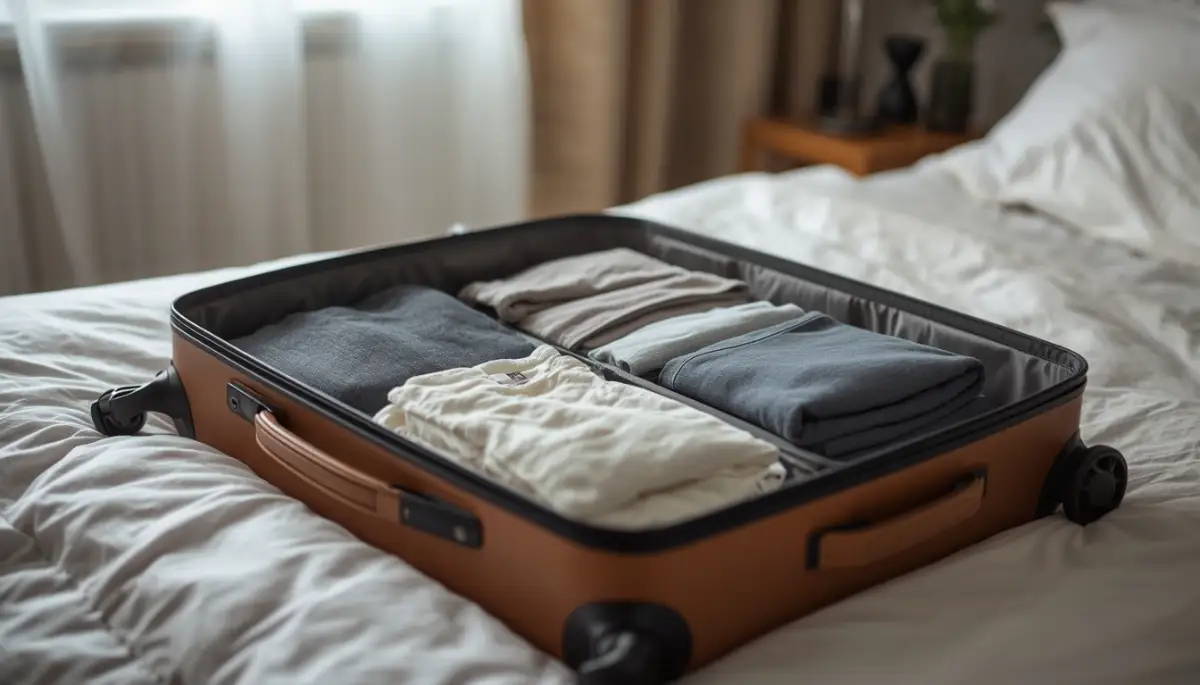
By squeezing your bulky clothing down, you can fit everything into a single carry-on bag without overstuffing the outer pockets.
Overstuffed outer pockets are the primary reason why gate agents force travelers to measure their bags in airport sizers.
According to global packing guidelines from the IATA international baggage standards, keeping your bag's outer dimensions uniform is necessary to fit overhead bins.
Taking these packing precautions ensures your bag glides smoothly into the overhead compartment without any struggle.
The Credit Card Baggage Insurance Shield
Another expert-level secret is to pay for your flight tickets using a premium travel credit card that includes built-in baggage protection.
Many major credit cards automatically cover lost, damaged, or delayed luggage if you use their card to book the fare.
If your checked suitcase is delayed by more than six hours, these policies reimburse you for essential clothes and toiletries.
Before booking your ticket, check your credit card's benefits guide to understand their exact claim requirements and coverage limits.
However, make sure you manage your card balances responsibly so you do not accumulate high interest charges.
Spent time understanding the true cost of credit card interest to ensure your travel rewards are not canceled out by monthly finance fees.
Using credit card protection gives you a financial safety net if the airline misplaces your luggage during transit.
It provides peace of mind, knowing you will not have to pay out-of-pocket for emergency clothes in a foreign city.
Safeguard Electronics and Power Banks
When packing your carry-on, pay extra attention to where you store your laptop, camera gear, and lithium-ion power banks.
Security screeners require you to remove large electronics from your bag at the security checkpoint.
Packing these items near the top of your bag allows you to slide them out quickly without messing up your clothes.
Remember that all spare lithium-ion batteries must remain in your carry-on luggage due to strict aviation fire safety rules.
Reviewing protecting smartphone battery health can help you understand how heat and power draw affect portable batteries.
Official guidelines from the TSA liquid and item guidelines require all spare power banks to be carried inside the cabin where crew members can monitor them.
Keeping your electronics accessible speeds up your time in the TSA line and keeps your flight fully compliant.
It prevents security agents from opening your checked suitcases to search for forgotten battery packs.
Do's and Don'ts for Stress-Free Airport Packing
- Do take a quick photo of the inside and outside of your checked suitcase before handing it to the counter agent.
- Do keep your essential medications, passport, and one change of clothes inside your personal item bag.
- Don't pack fragile glassware or valuable jewelry inside your checked luggage where it can break.
- Don't wrap your suitcase with excess tape or straps that prevent security agents from inspecting the locks.

Hidden Sandtraps: The Emotional Mistakes That Lead to Gate Penalties
When we are excited to embark on a long-awaited vacation, our minds naturally focus on the fun activities ahead.
We tend to ignore boring logistical details like luggage weight limits and airline fare class restrictions.
However, ignoring the fine print on your baggage allowance is the fastest way to ruin your vacation mood.
The most common trap is assuming that connecting flights on different airlines share the exact same baggage allowance.
If you book a multi-leg journey with two separate airline partners, their carry-on weight limits might be completely different.
For example, a major international carrier might allow a twenty-two-pound carry-on, while their regional partner limits you to fifteen pounds.
When you board the smaller regional aircraft, the gate agent will force you to check your bag and pay an extra fee.
According to passenger consumer rights outlined by the Department of Transportation airline passenger rules, baggage rules on multi-carrier tickets depend on the primary operating airline.
Ignoring these subtle fare differences is similar to avoiding early startup legal errors where small paperwork oversights cause massive financial penalties later.
To avoid this trap, check the baggage allowance for every single leg of your journey on your official itinerary.
If one airline has a stricter weight limit, pack your bags to satisfy the smallest allowance on your route.
Overpacking "Just in Case" Items
Another severe mistake is filling your suitcase with extra outfits and heavy shoes that you will never actually wear.
Travelers often overpack out of a fear of being unprepared for unusual weather or unexpected events.
This extra weight pushes your suitcase over the fifty-pound limit, triggering a massive overweight fee at the counter.
When your suitcase is packed over its capacity, the seams and zippers experience high physical strain during transit.
If an airport baggage handler tosses an overstuffed bag, the zipper can burst open, scattering your personal items across the tarmac.
Paying attention to small details prevents major disasters, much like avoiding federal aid filing errors ensures your academic plans stay on track.
Using Rigid Hard-Shell Suitcases That Fail Sizer Tests
Many travelers prefer glossy, rigid hard-shell suitcases because they look modern and protect fragile items well.
However, hard-shell bags have zero flexibility when you try to fit them into tight overhead bins or metal airport sizers.
If your har