The Frustrating Cycle of Robotic Replies
Type "write a blog post about healthy eating" into any AI chatbot, and you get generic filler about drinking water and eating vegetables. Add one sentence of context, a role, an audience, or a tone, and the exact same tool suddenly writes something worth reading. The machine was never the problem. The instructions were just too thin, and that is the easiest thing in the world to fix once you see how.

Quick Summary: Upgrading Your AI Interactions
- The Context Void: Machines cannot read your mind. If you do not provide deep background details, they will always default to safe, boring answers.
- The Power of Persona: You must explicitly tell the algorithm exactly "who" it is supposed to be acting like before it starts writing.
- Setting Strict Boundaries: Giving the system absolute rules about what not to say is just as important as telling it what to write.
- The Iterative Dance: A perfect prompt is rarely achieved on the first try; it requires a short back-and-forth conversation to refine the final output.
Quick Takeaways Before You Write Your Next Prompt
- Give the machine a role and a tone, not just a topic, to avoid generic output.
- Add specific context about your situation, the machine cannot guess what it does not know.
- Tell it what to avoid, not just what to do, negative rules work just as well as positive ones.
- Treat the first response as a draft, refine it through a short back-and-forth instead of starting over.
Diagnosing the "Blank Canvas" Problem
To fix this incredibly annoying problem, we have to completely change how we view these digital assistants. Most people treat a language model exactly like a standard Google search bar.
When you use a search engine, you type three or four random keywords and expect the system to figure out the rest. If you treat a generative algorithm like a basic search engine, you will always get terrible results.
These massive neural networks have consumed almost the entire internet during their training phase. They hold the combined knowledge of Shakespeare, quantum physicists, and cheesy marketing blogs all at the same time. When you give them a tiny, vague instruction, they literally do not know which part of their massive brain to use.
The Danger of the "Lazy Ask"
Let us look at a real-world example of why things go so wrong so quickly. Imagine you want to write a short blog post about healthy eating.
The average user will open their chat window and type: "Write a blog post about eating healthy." This is what prompt engineers call a 'Lazy Ask,' and it guarantees a robotic response.
Because you did not give the machine any specific direction, it panics and averages out every single article it has ever read about food. It will spit out generic advice like "eat more vegetables" and "drink eight glasses of water." It removes all personality, humor, and unique perspective just to play it safe.
My absolute biggest mistake when I first started using these tools was assuming the machine magically understood my specific audience. I would ask it to write social media captions for a highly technical software product, and it would spit out emojis and childish slang. I finally realized that because I didn't explicitly tell the machine my audience was composed of serious corporate executives, it just guessed, and it guessed horribly wrong.
Introducing the Role-Playing Technique
The absolute fastest way to kill generic output is to force the algorithm into a very specific box. You must assign the machine a clear, professional identity before you ask it to do any actual work.
This technique is called Role Prompting, and it instantly changes the vocabulary the machine decides to use. Instead of just asking for an article, you have to set the stage perfectly.
You should start your prompt by saying: "Act as a senior nutritionist with twenty years of clinical experience. Your writing style is highly empathetic, scientifically accurate, and very encouraging." By defining the persona upfront, you instantly cut away 90% of the generic internet fluff hiding inside the database.
Before we look at how to build the perfect command structure, watch this incredibly helpful visual breakdown of how role-playing drastically changes an algorithm's output.
Interactive Markdown Table: Weak vs. Strong Commands
It is very easy to fall back into lazy habits when you are rushing to meet a deadline. Let us compare the exact same request using a weak, generic format versus a highly structured, professional format.
Constructing the Ultimate Command Formula
Now that we understand why the machine defaults to boring text, we can easily build a system to fix it. You do not need to memorize complex coding languages to command these tools properly.
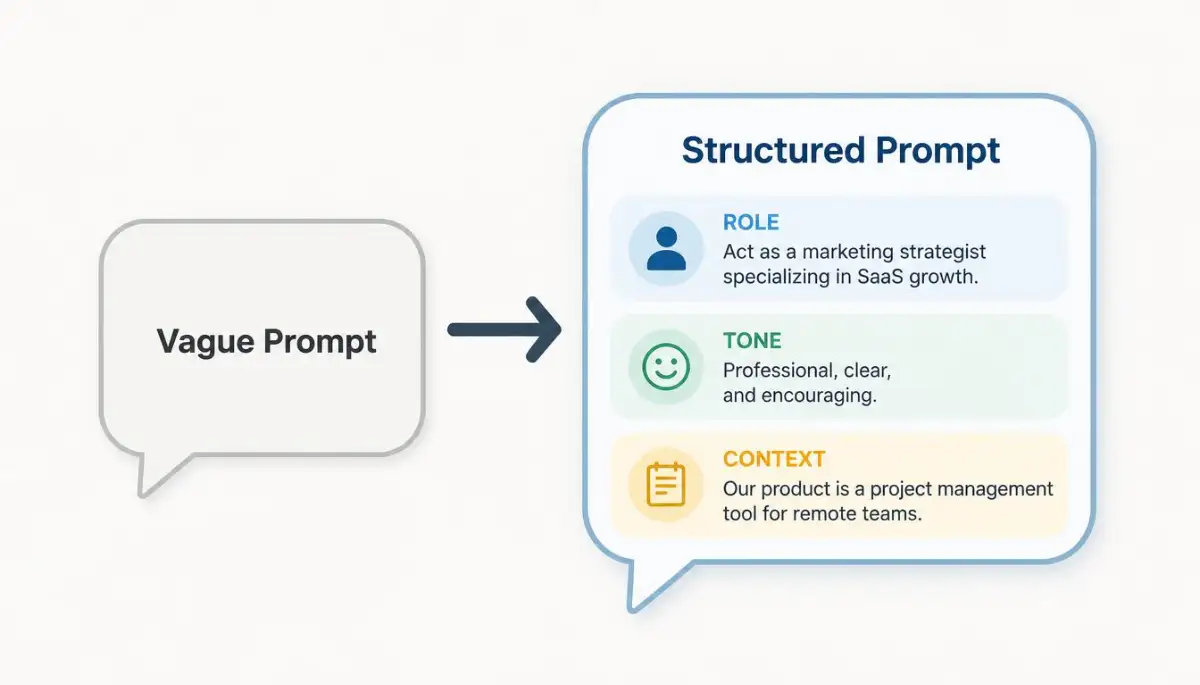
You just need to follow a very strict, repeatable recipe every single time you open a chat window. Think of this formula as a simple checklist that guarantees high-quality, human-sounding results.
Step 1: Providing the Necessary Context
We already talked about assigning a role, but the machine also needs to understand the specific environment you are working in. The algorithm cannot see your current business situation or your daily struggles.
You must manually build the world for the machine before asking it a question. If you want marketing advice, you cannot just ask, "How do I sell more shoes?"
You need to write: "I own a small, independent running shoe store that caters specifically to marathon runners. My biggest current struggle is competing with massive online retailers who offer cheaper prices." By providing this deep situational context, the machine immediately stops giving you generic retail advice and focuses entirely on niche marathon marketing.
See It in Action:
Weak: "Write a caption for my bakery's new sourdough bread."
Strong: "Act as the owner of a small neighborhood bakery. Write a warm, three-sentence Instagram caption announcing a new sourdough loaf, mentioning the tangy smell and the 24-hour fermentation process. Keep the tone friendly, not salesy."
The second version gives the machine a job title, a tone, and a specific detail to anchor on, which is exactly why it reads like a real person wrote it.
Step 2: Setting Strict Output Constraints
If you want the machine to sound like a human, you have to tell it exactly what a human sounds like. Left to its own devices, artificial intelligence loves to use overly complex, robotic transition words.
You must establish firm, unbending rules about what the machine is absolutely not allowed to do. These negative constraints are often more powerful than your positive instructions.
At the end of your prompt, add a strict rule block: "Do not use robotic transition words like 'furthermore,' 'delve,' or 'in conclusion.' Do not use complex corporate jargon. Keep every paragraph under three sentences long." This simple list of strict boundaries instantly forces the text to feel significantly more conversational and natural.
Quick Checklist: Does Your Prompt Have These Four Things?
- A role for the machine to play (who is writing this?)
- Context about your specific situation (what makes this different from a generic request?)
- A clear tone instruction (friendly, formal, playful?)
- At least one thing the machine should avoid (jargon, long paragraphs, certain words?)
If your prompt is missing two or more of these, expect a generic answer.
Step 3: Providing the Perfect Example
The absolute holy grail of prompt engineering is a technique known as "Few-Shot Prompting." This is a fancy technical term for simply showing the machine an example of what you actually want.
Telling an algorithm to be funny is very difficult; showing it a joke makes it instantly understand your specific sense of humor. If you want the bot to write a newsletter in your exact personal voice, you must feed it a sample of your previous work.
You can type: "Here is an example of an email I wrote last week. Analyze the casual tone, the short sentence structure, and the specific vocabulary I use. Now, write a new email about upcoming software updates using that exact same personal style." Providing a template is the absolute fastest way to bypass the generic, robotic tone entirely.
Pro-Level Habits for Brilliant Output Every Time
Building a strong, structured command is an amazing first step, but true professionals do not just stop there. If you want your daily content to sound incredibly sharp and deeply personal, you need to establish a few hidden routines.
You do not need to be a coding genius to make these algorithms bend perfectly to your will. Let us explore the expert-level strategies that top writers use to pull genuine magic out of these massive digital brains.
These advanced habits are surprisingly easy to adopt, and they will completely remove the robotic, clunky feeling from your daily drafts.
The Power of Iterative Chaining
The biggest mistake beginners make is expecting the very first response to be an absolute masterpiece. When an experienced prompt engineer gets a mediocre response, they do not just delete the chat and start over from scratch.
They use a technique called "Iterative Chaining," which is essentially having a polite debate with the algorithm. Instead of writing a brand new prompt, you simply correct the machine's mistakes in the exact same chat window.
You reply by saying: "That is a good start, but the second paragraph is far too formal. Rewrite only the second paragraph using a much friendlier tone, and completely remove the bullet points." By continuously tweaking the previous answer, the machine slowly learns your exact preferences until the final draft is absolutely perfect.

If you are trying to speed up your content creation process, learning ai tools that cut your work time in half no tech skills needed is heavily dependent on mastering this quick back-and-forth feedback loop.
Building Your Personal Prompt Library
Once you finally nail the perfect command structure for a specific task, you absolutely must save it. Professional writers do not reinvent the wheel every single time they need to write a new newsletter or a social media caption.
They build a private, digital library of their most successful command templates. You can use a simple Google Doc or a notes app on your phone to store your winning formulas.
When it is time to work, you just copy the template, change the core topic, and paste it into the chat window. According to workflow researchers at the Nielsen Norman Group on digital productivity, standardizing your daily inputs is the absolute fastest way to drastically increase your overall output quality.
If you frequently find yourself drowning in spreadsheets a beginner s guide to workflow automation scripts, organizing your prompts into a simple, copy-paste format will save you countless hours of repetitive typing.
Injecting High-Quality Knowledge Directly
Language models often struggle with complex, highly niche topics because their massive training data is extremely generalized. If you ask a bot to write about advanced medical devices, it will likely hallucinate fake facts just to fill the page.
To completely stop fake facts, you must feed the machine your own trusted research first. You do this by copying a verified, high-quality article from the internet and pasting the entire text directly into the chat window.
Your prompt should say: "Read the text pasted above. Using only the facts provided in that text, write a short, engaging summary for my specific audience." By aggressively locking the machine inside the walls of your provided text, you completely neutralize the risk of the algorithm inventing fake, dangerous information.

The Dangerous Habits That Ruin Your Drafts
Even when people figure out how to structure their requests, they often make terrible, emotional decisions while typing. When you are rushing to finish a heavy workload, the sheer panic makes you skip over tiny but highly important details.
Let us break down the most severe, real-world mistakes people make when trying to communicate with these algorithms. Avoiding these specific pitfalls will ensure you do not accidentally generate confusing, embarrassing content.
The "Too Much at Once" Disaster
This is easily the most common mistake a beginner can make, and it happens very frequently when deadlines approach. People try to squeeze ten different, complex tasks into a single, massive paragraph.
Imagine you type a prompt that says: "Write a blog post about running shoes, create ten social media captions, write a friendly email to my boss about taking Friday off, and give me a recipe for chicken soup." When you overload the machine with conflicting tasks, it completely panics and performs all of them terribly.
The algorithm has a limited "attention span," and packing too many requests forces it to spread its focus incredibly thin. You must always break your massive ideas into several small, independent chats. Ask for the blog post first. Once that is perfectly finished, open a brand new chat window and ask for the social media captions.
Accidentally Leaking Private Information
When you are desperately trying to give the machine enough context, it is incredibly easy to cross a highly dangerous line. Many professionals unknowingly compromise their entire career simply because they wanted the algorithm to understand their specific problem better.
People constantly paste raw, unedited financial documents or private client emails directly into public chat windows. You must always remember stop sharing secrets why public ai tools are a massive privacy risk before you feed sensitive data to an external server.
Anything you type into a public interface is permanently absorbed into the company's training database. Always take the time to manually scrub out real names, specific dollar amounts, and confidential passwords before hitting the enter key.
Trusting the Algorithm's Math Skills
Because these digital assistants speak with such supreme confidence, we naturally assume they are incredibly smart at everything. This is a massive, dangerous illusion, especially when it comes to basic arithmetic.
Large language models are essentially highly advanced autocomplete engines; they predict the next logical word, they do not actually calculate numbers. If you ask a chat interface to balance your monthly business budget or calculate complex tax percentages, it will very confidently give you the wrong answer.
If you need to crunch heavy numbers, you should always stick to dedicated software. Learning stop typing the same emails how to automate your inbox like a pro using proper spreadsheet tools is far safer than trusting a language model to handle your finances.
Using Emotional or Angry Language
When the machine completely misunderstands your request for the third time in a row, your human frustration naturally takes over. People start typing angry, highly sarcastic, or deeply emotional insults directly at the bot.
Typing "You are completely stupid, do it again" actually ruins the mathematical logic of the conversation. The machine does not understand human sarcasm; it just sees a sudden shift in the emotional tone of the prompt.
It will try to match your angry tone in its next response, resulting in a completely chaotic, aggressive draft. Always keep your instructions incredibly calm, highly objective, and purely professional, no matter how frustrating the process becomes.
Frequent Questions About Prompt Engineering
Do I need to learn how to code to write perfect prompts?
No, you absolutely do not. Prompt engineering is not a programming language like Python or C++; it is entirely based on clear, structured human communication and basic logic.
Why does the machine sometimes give me completely fake facts?
This is a known technical flaw called a "hallucination." When a language model does not know the exact answer to your specific question, its algorithm forces it to guess confidently, which often results in highly believable fake information.
Does starting a brand new chat window change the final output?
Yes, it changes everything. A new chat window completely wipes the machine's short-term memory, giving you a fresh, clean slate without the baggage or context of your previous conversation.
Should I say "please" and "thank you" to the algorithm?
While it is a nice human habit, it is mathematically completely unnecessary. The machine does not have feelings, and polite filler words actually consume valuable processing space that could be used for your actual instructions.
Your Final Checklist for Flawless Content
You do not have to live in constant, heavy frustration, wondering why the machine keeps spitting out robotic, generic fluff. These incredible tools are massive assets, and you now know exactly how to point them in the right direction.
By confidently assigning specific roles, setting incredibly strict negative boundaries, and feeding the machine trusted examples, you give yourself the absolute power to generate brilliant text instantly.
Disclaimer: The information provided in this article is for educational and informational artificial intelligence productivity purposes only. It should not be considered professional IT or direct data administration advice. Software interfaces and algorithm capabilities vary greatly, and you should always carefully review and manually fact-check any text generated by artificial intelligence before publishing it publicly.